The penitentiary
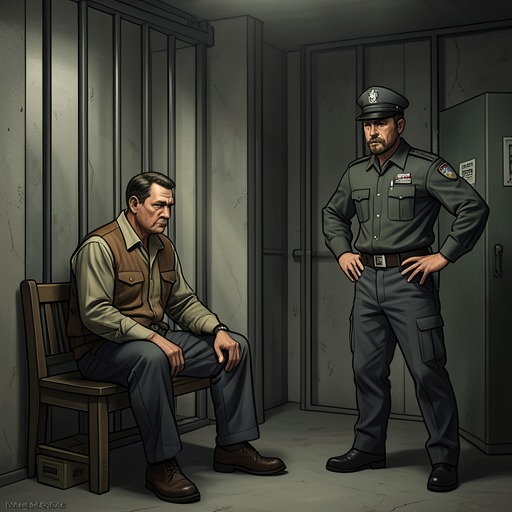
Kiss of the Spider WomanThe penitentiary is the unnamed prison where Molina and Valentin are confined, a setting that shapes their access to one another and the limits of their daily lives. It is presented not through a full architectural description but through records, cell changes, official summonses, and conversations: an institution whose control is felt in where prisoners are housed, whether they may remain together, and when ordinary needs such as dinner are met.
Identity and Setting
The evidence does not give the institution a personal name or a comprehensive physical description. An official record situates Molina within its system of numbered pavilions and cells; a later surveillance report identifies the penitentiary as a visible destination from a window, toward the intersection of Calle Juramento and Bauness. The setting is therefore defined less by a panoramic account of its buildings than by the way its spaces are assigned, watched, and experienced by people inside and outside its walls.
The surveillance report notes that a person at the window looks toward the site of the penitentiary rather than down at the streets. This detail places the prison within a wider urban landscape while also making it an object of attention from outside. The institution is both a place of confinement and a fixed point in the city’s field of observation.
Sentencing and Prison Administration
Molina’s record gives the institution a precise administrative history. He was sentenced on July 20, 1974, by Judge Justo José Dalpierre, Criminal Court of the City of Buenos Aires, to eight years’ imprisonment for corruption of minors. On July 28, he was lodged in Pavilion B, cell 34, with Benito Jaramillo, Mario Carlos Bianchi, and David Margulies. The entry describes his conduct as good, reducing a life in prison to concise official notations of offense, term, placement, associates, and behavior.
The same record marks a consequential change in his placement: on April 4, 1975, Molina was transferred to Pavilion D, cell 7, which housed political prisoner Valentin Arregui Paz. The administrative act of moving him between cells becomes the condition for sustained contact with Valentin. The prison thus brings the two men together by means of its classification and allocation of bodies, even as its rules retain the power to separate them again.
Daily Confinement and Uncertainty
The institution’s control appears in small, immediate concerns as well as formal records. Waiting for dinner, Molina wonders whether it has already been brought to the next cell. The moment offers no complete account of the prison’s meal system, but it shows how the timing and distribution of food enter the prisoners’ conversation and attention.
The threat of a further cell transfer carries a more personal consequence. Molina fears that he may be moved elsewhere, kept inside, and prevented from seeing Valentin again. The uncertainty is not only about where he will sleep: a change in the prison’s spatial arrangement could interrupt the companionship that the shared cell has made possible. When the Warden summons Molina, the brief official instruction likewise recalls that prison encounters occur under the authority of staff and can be redirected by them.
The Cell as Narrative Space
The prison’s enclosure forms a counterpoint to the expansive scenes narrated within it. In the conversations associated with the cell, the accounts range from a Paris music hall, with its chorus and a performer descending a staircase, to a country house around a blind pianist, and to the masked ball at the Mardi Gras of Veracruz. These settings belong to stories being told, not to the prison’s physical surroundings. Their contrast with the cell makes narration a way of imagining places that confinement excludes.
The distinction between enclosed present and narrated elsewhere is especially clear when a film image of a woman in a silver dress and mask is recalled alongside the cell dialogue. The account can supply a stage, a jungle, music, and changing light; the prison remains the material setting from which those images are spoken and heard. In this way, The penitentiary is more than a backdrop: it confines the speakers while also providing the shared, restricted space in which storytelling and personal connection can develop.